The first social psychology theories of power argued that power could only be understood within a social field (Lewin, 1951), meaning among people who’s social distance was directly (and inversely) related to how much power—social influence—they had over each other. In fact, the analogy Kurt Lewin** used to describe a “social field” is that of a “force field.”
The force field analogy helps us understand human power as dynamic, complex, having multiple relevant actors, and being about possibilities.
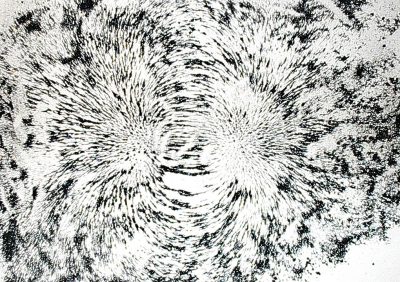
Imagine a sandwich: A piece of cardboard, a few magnets glued to it, topped by a sheet of paper. If you sprinkled iron filings on the paper, you would see the filings array themselves in response to the magnetic fields produced by magnets. Bigger magnets would influence filings farther away than would smaller magnets. With multiple magnets, one would not get a simple pattern as one does with one magnet—the filings would be subject to the magnetic force of every magnet, but be influenced by them depending on magnetic strength and distance from the magnet. The pattern of the filings shows the strength of potential influence of each magnet to the others.
Now, suppose we unglue the magnets. Then the magnets would move in response to the magnetic fields of each other and whether they attract or repel each other. The filings would of course rearrange to follow the motion of the set of magnets. If somebody bumps the table, or brings a new magnet or moves one, the magnets might never settle down to rest. We know that in social life, there likewise might be situations that are common and stable, but they are never fixed.
The points Lewin wanted to communicate about human power are that 1) power is about relationships (i.e., “relational”), but how much power is possible between any two persons depends on how much one is in the other’s orbit, 2) power is fluid – so it is not a fixed property of a person like an authority role might be, and any given power relation can always change, 3) power is not just a matter of only two parties.
Lewin made another point that helps show just how complex power is—and this one is psychological:
People do not just passively react to each other according to universal laws (unlike magnets). Instead, people often consider the possible consequences of their actions on how others might behave, and then they consider what those possibilities would mean for themselves and others, and so on. (In fact, I “know” certain anxious types who can imagine any number of possibilities on possibilities on possibilities…)
True, sometimes we don’t think before we act. But there are all kinds of important psychological theories telling us that we can deliberately and often habitually DO think of the consequences of our actions (whether this turns out to be accurate or not). For example, in one brilliant Family Circus cartoon (by Bil and Jeff Keane), one brother tells the other “Conscience is like Mommy telling you not to do something’, only she’s not there.”) You probably know what kinds of remarks will be funny to some of your friends, but not to other friends. Trying to predict what other people will like, dislike, and do is an essential process to power dynamics—that’s how “lay people” (that is, everyone) lives like a social psychologist. In other words, what influences what actions people take or eschew is not just whether they can or cannot do something — power is not just the absence or presence of freedom. What influences people is what they believe is possible, and likely. This means that power is really a potential thing.
Measuring possibilities in social life is not easy. I think this is why formal empirical studies of power dynamics (rather than simulations) remain rare. (See The In Game Method).
** (Lewin originally was pronounced “Levine” because it is a German name, but he Americanized it—Kurt Lewin was a German Jewish refugee to the U.S. pre-World War II, one of many Jewish European scientist who was very important in developing science in the U.S.) Wikipedia
Bibliography
Lewin, K. (1951). Field theory in social science: Selected theoretical papers (Edited by Dorwin Cartwright.). Harpers.