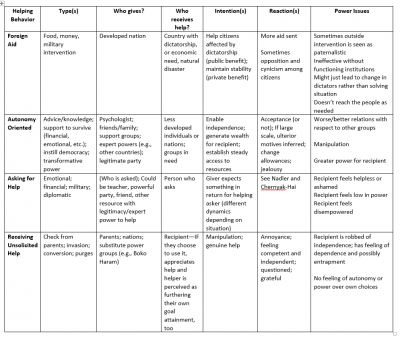
Write the Column Headings from the table below on the board. Then first, ask the students to provide examples of helping-related behavior in the rows of the first (violet) column. From concrete circumstances, they should be able to describe their examples by filling in at least columns 3 & 4 (periwinkle), and perhaps 5 & 6 (mint green). Columns 5 & 6 are very much about the perceptions and psychologies of the parties involved. If they have done the readings you assigned, then presumably they van also fill in the last (chartreuse yellow) and 2nd (lavender) columns also, for each row.
Here are a few examples of helping that could be put in the first column: Foreign Aid, Mansplaining, Tutoring a friend, Loan — you might like ones you had them read research or news articles about, or let them generate their own. As long as there is some variety (e.g., type of parties involved, thing given, social positions of giver and recipient) the exercise can illustrate the possibilities.
For students who have not had much exposure to theory/data/analysis about power and helping, it is helpful to focus on the concrete questions about the example before you necessarily have them address , with their knowledge or beliefs about examples of the kinds of helping behaviors in each row and write them up. Then, as a group, have them then complete the rest of the columns.
This exercise is useful for helping students recall or explain particular examples they have learned about to classmates, and use important power concepts to compare and contrast types of helping.
By type or category of helping, here are some of the distinctions often made in the conceptual and research literatures:
autonomy-oriented (will help enable the recipient to become independent in ability to meet needs) or dependency-oriented (Will maintain the dependence of the recipient on the giver)
Altruistic or Selfish (Both can be discussed re the “official” public reasons given, the actual consequences, and the intentions).
| 1
EXAMPLE OF HELPING |
2
Type/Category of Helping |
3
Who Gives Help? What is given? |
4
Who Receives Help? |
5
What is the Giver’s Intention? |
6
What is the Recipient’s Response to Help? |
7
What Issues/Social or other Human Problems Does this behavior solve? Create? |
Below is how one of my classes completed the table. — We did this in reference to articles on foreign aid and Nadler & Chernyak-Hai (2013) papers about dependency-oriented and autonomy-oriented helping. You could use other readings and/or let students generate their own examples of helping, and then have them categorize those into similar categories as those below, if you desired.